The stereotypical image of a mathematician is that of an old man sitting alone in a room, surrounded by floor-to-ceiling bookshelves, papers strewn across the table, and perhaps a blackboard filled with equations. The reality could hardly be farther from this image. The bookshelves and chalkboards and papers all around bit is still true to an extent. The ‘man’ part and the ‘alone’ part are not. Mathematicians come from all backgrounds, a lot of them are women, and collaboration is central to how mathematics is done. They exchange ideas with others who work on similar problems, they borrow and lend, and build on one another’s work to arrive at the discoveries. (If not for my friend pretending to be my copy editor, this is where I would have taken a history detour to Emmy, Euler and Euclid.)
Why is the stereotype a problem? It is because it influences who imagines themselves belonging in mathematics. It affects the diversity of ways of thinking in mathematics. It affects the growth of mathematics. It even affects how people who may have made it into academic mathematics are treated by funding agencies, institutional culture, the media, the larger public, etc.
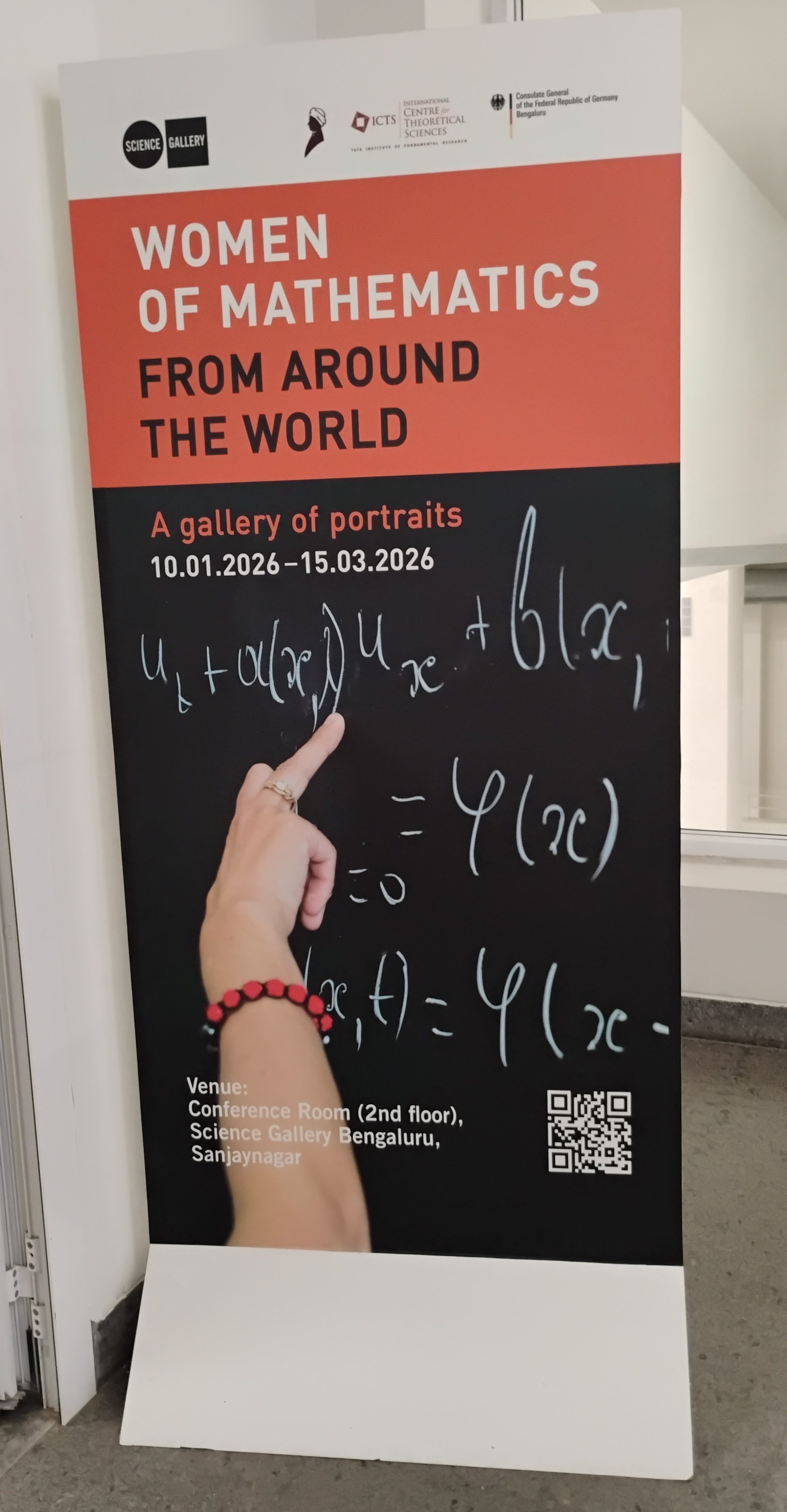
A great deal of effort is now devoted to dismantling this outdated image and presenting the reality. One among many such efforts is the Women of Mathematics1 project. It is a collection of photographs of mathematicians from around the world who identify themselves as women. The photographs accompany excerpts from the interviews of these mathematicians. The interviewer is Sylvie Paycha, a mathematician and the photographer is Noel Matoff.
A discussion meeting2 was held at ICTS-TIFR, and as part of this program we organised a photo exhibition featuring portraits of 19 mathematicians from the Women of Mathematics project. The exhibition was later moved to Science Gallery Bengaluru to reach a wider audience. Alongside it, we planned a series of public mathematics activities called Maths is Fun, and I had the opportunity to develop and facilitate them.
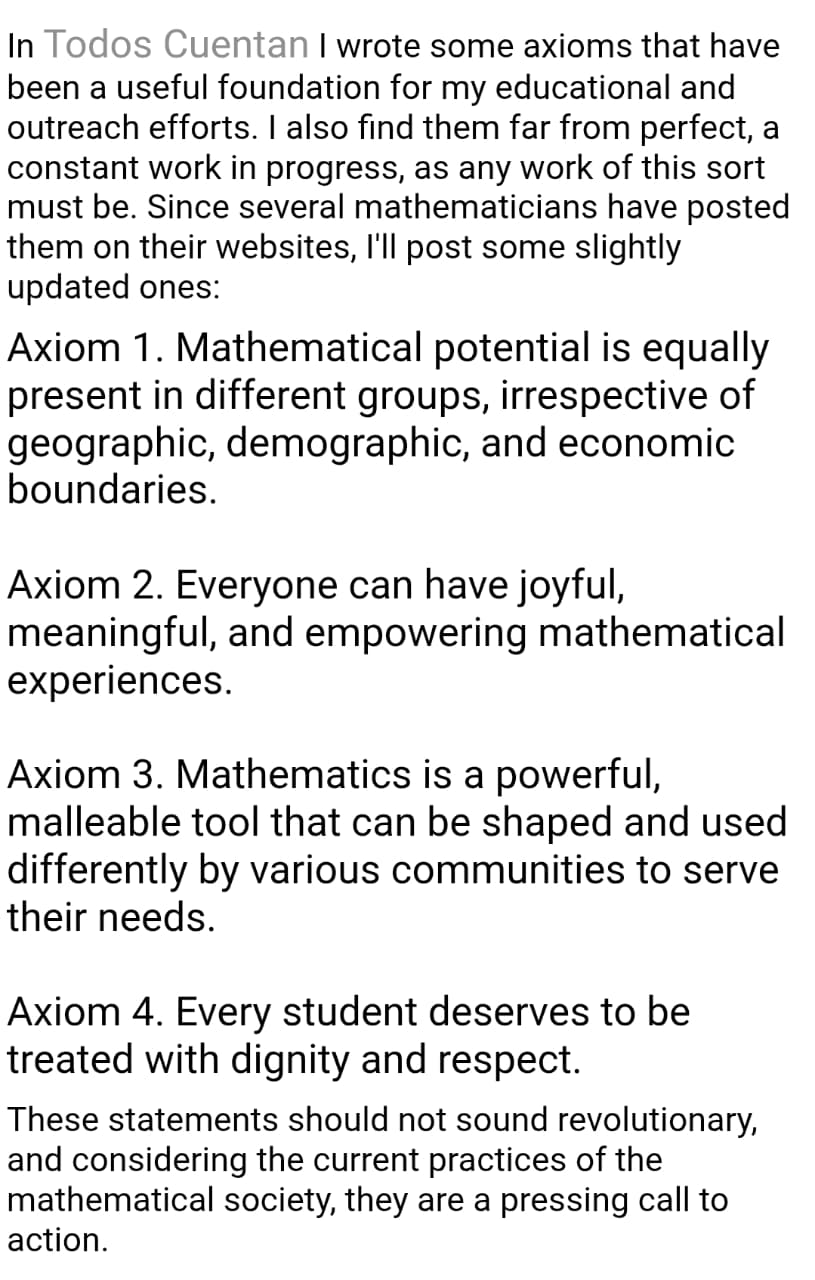
I was lucky that there was broad agreement among those involved on the choice of topics and the overall direction of the programme. This meant that I could spend more time in designing the activities. Maths is Fun was developed for the young adult, a general audience of age 15 and above, with no prerequisites for participation. The sessions were designed to provide a low barrier to entry. (In the image you can see the axioms used by Federico Ardila Mantilla in their educational efforts, I borrow from them.)
The design of the Maths is Fun activities were guided by four ideas that I care deeply about.
The first is that mathematics does not have to be centred around calculation. A great deal of mathematics can be explored through tactile and hands-on activities. That belief inspired the first set of activities, which focused on paper folding.
The second principle is that much of mathematics can be observed in the world around us. Physics education often embraces this approach, encouraging learners to understand concepts by observing natural phenomena. Unfortunately, mathematics classrooms do not make enough use of this perspective. That belief informed the second set of activities, which explored symmetry by looking at patterns in the surrounding world.
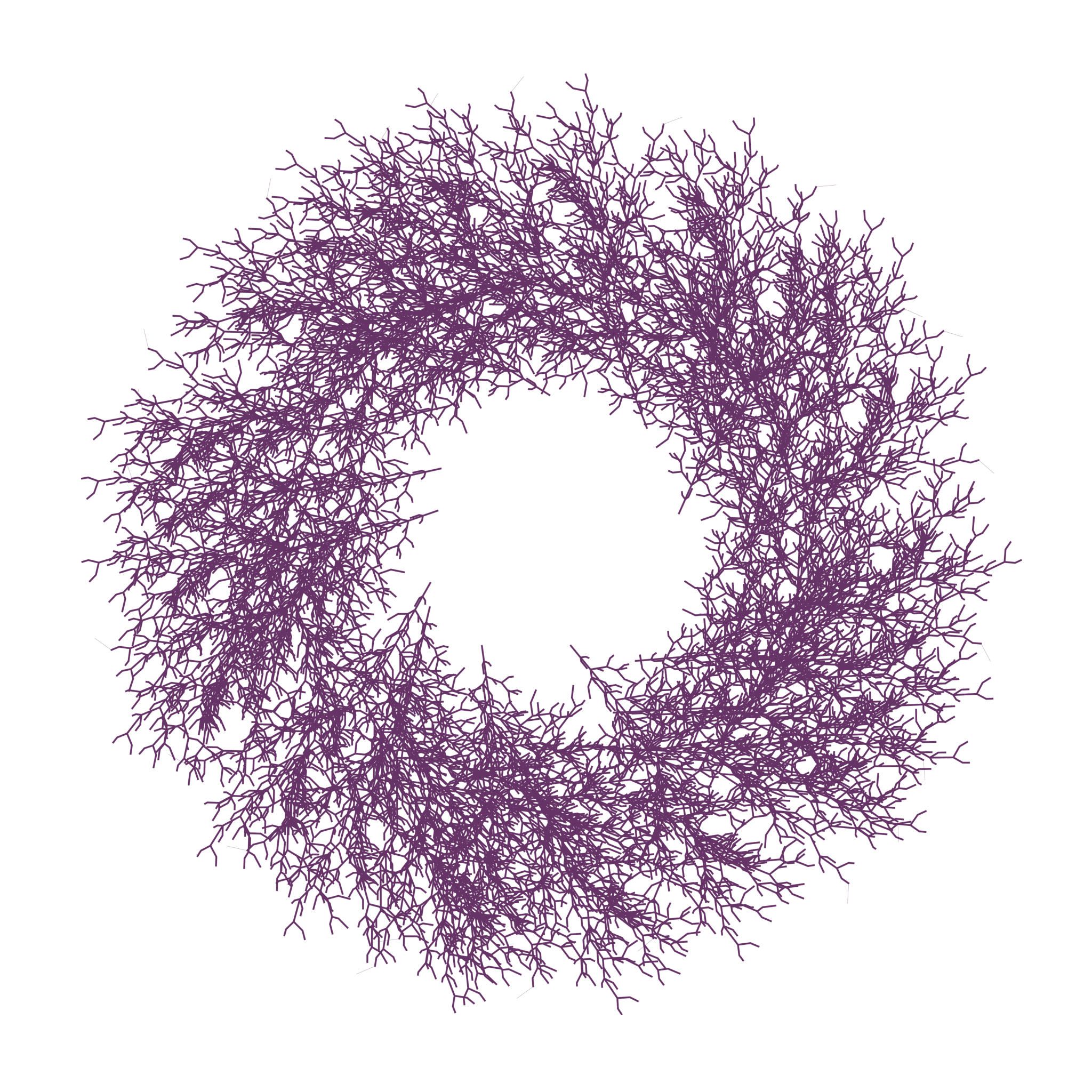
For the third set, I deviated slightly and used the opportunity to introduce the artistic side of mathematics through fractals (fractals are self-similar structures, imagine Russian stacking dolls). Being who I am, how could I let go of an opportunity to get a group of people to construct a room size carpet of penrose tiling or even better, a room size tiling of the sceptre tile? Fractals also provide an non-maths-seeming entry point for people who have long since “divorced” mathematics after having a toxic-relationship with it in school.
The fourth topic came from a suggestion by my supervisor and focused on minimal surfaces. Many fundamental principles in physics can be formulated in terms of optimisation, and minimal surfaces are a natural manifestation of optimisation principles. My supervisor believes—and I am beginning to understand why—that this is one of the most important mathematical ideas used in physics. In other words, we played with soap films.
This post serves mainly as an introduction to what I hope will become a series of four or five posts, one devoted to each activity. I want to document what was planned, what happened during the sessions, what could have been improved, and how participants responded. Writing this here also serves as a form of accountability for myself, so that I remember to sit down and write them.
References